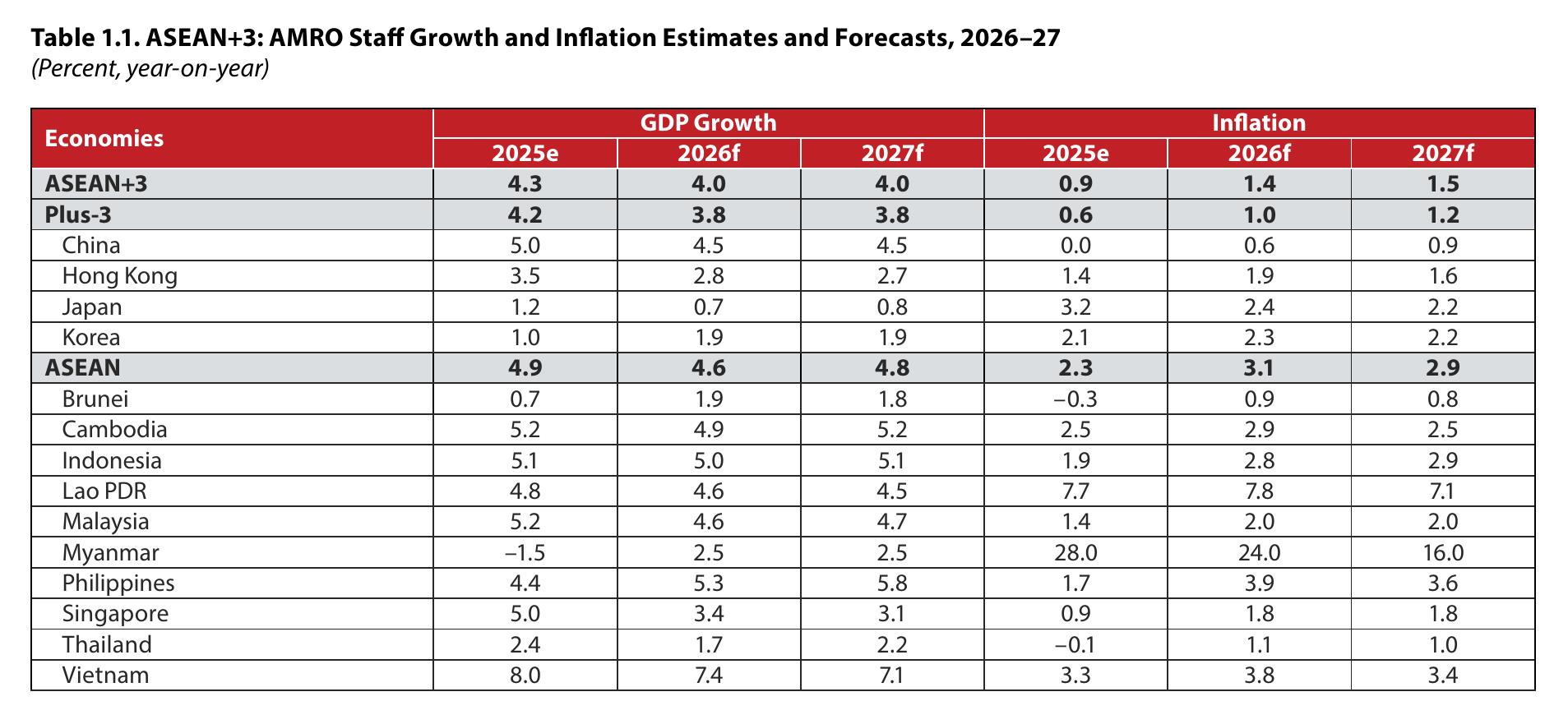
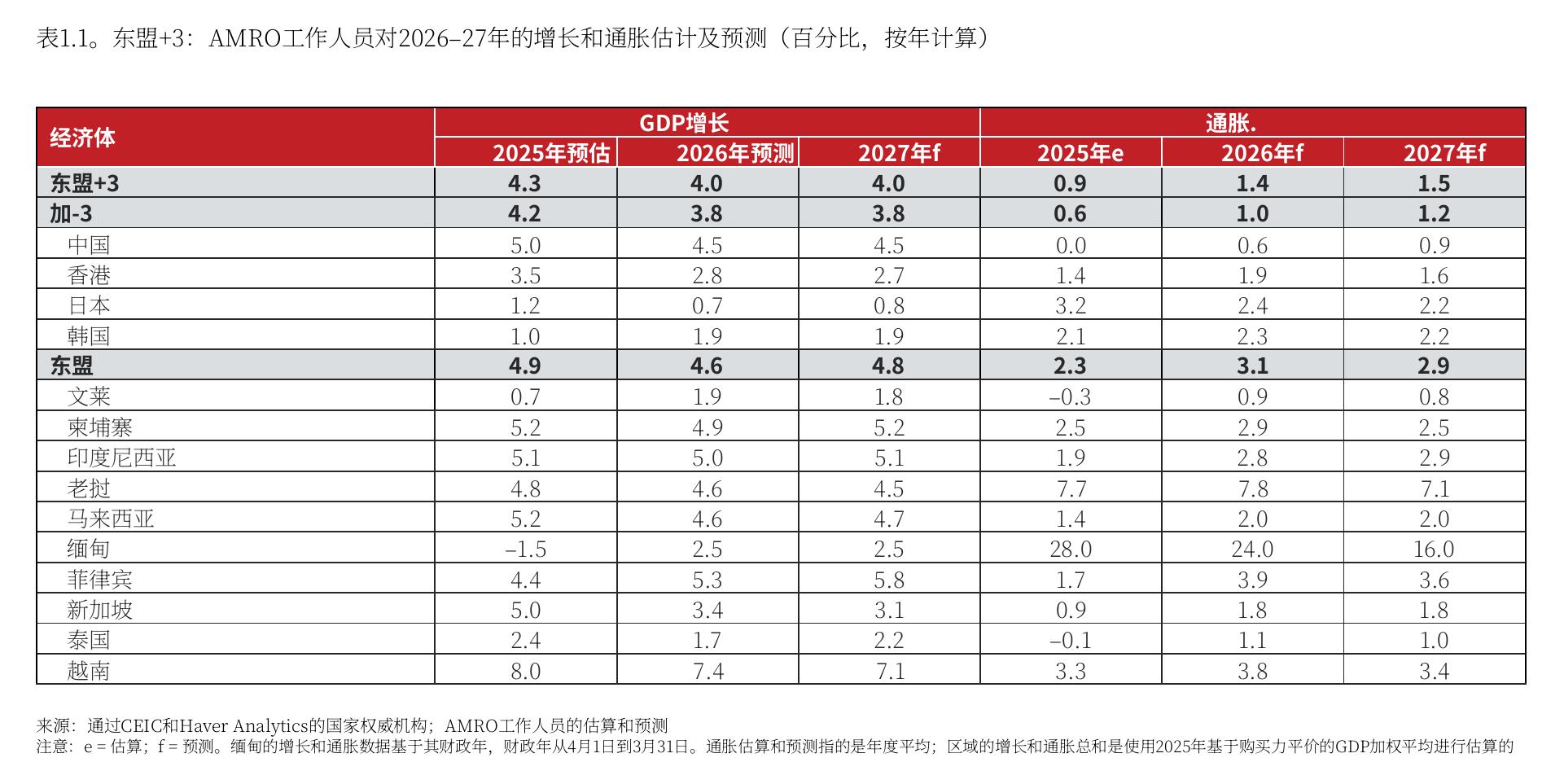
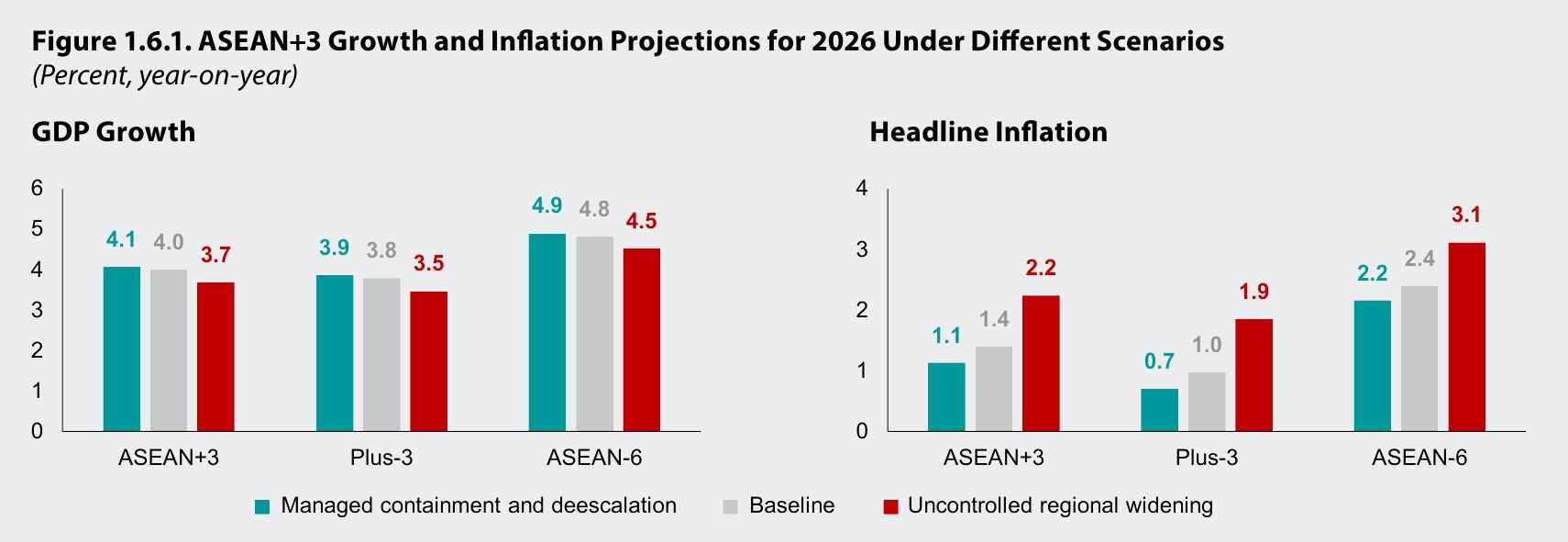
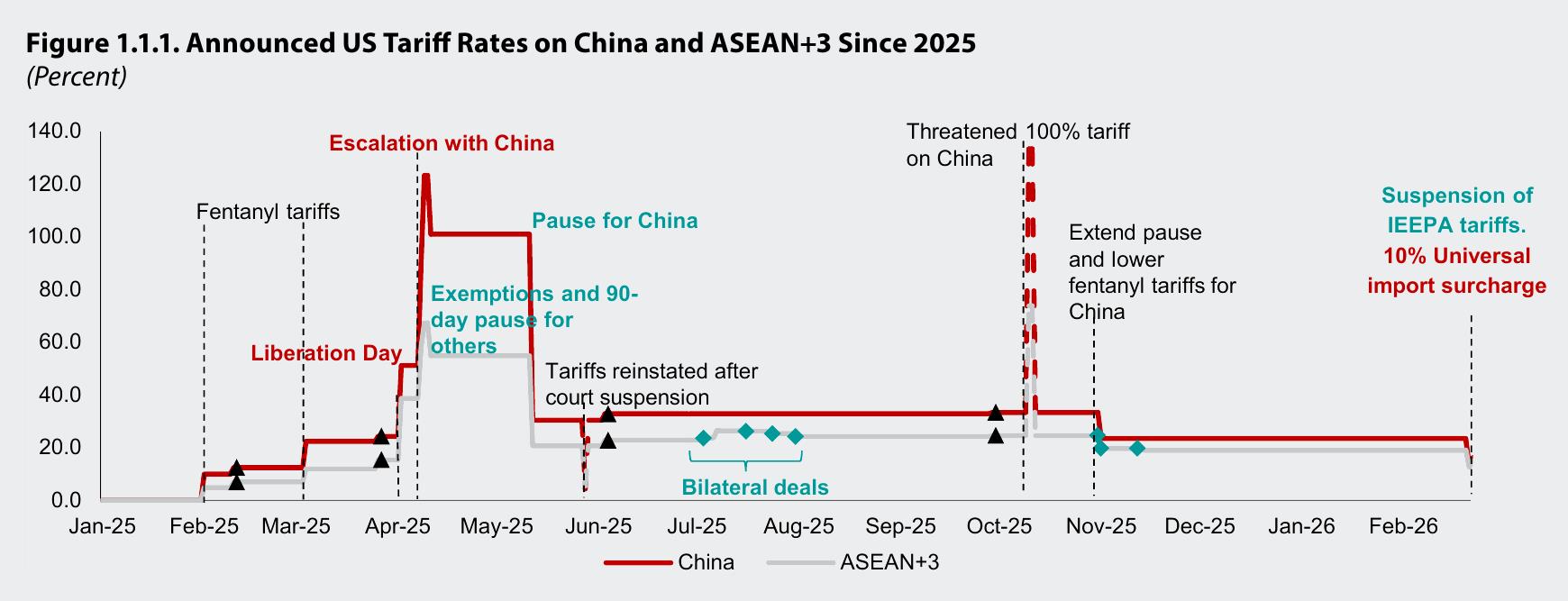
Chapter 1. Macroeconomic Prospects and Challenges PartIl. Outlook for ASEAN+3: Sustained GrowthAmid Elevated After a year of persistent uncertainties, global growth is and increase production costs. Technology-driven expected to continue at a moderate pace in 2026-27, with investment provides an important offset, with export higher inflation amid heightened geopolitical tensions. remain firm, supported by ongoing Al-related and data center investment, though at a more measured pace than underpinned by sustained investment in technology. driven sectors, resilient household consumption, the implementation of tax reductions, and accommodative remain the anchor of growth, with investment momentum financial conditions. Within the euro area, economic activity is anticipated to be moderate yet steady, as Plus-3. Growth is projected to moderate from 4.2 percent pressures arising from elevated energy costs. Global in 2025 to 3.8 percent in 2026 and 2027. In China, growth is volatile in the near term, reflecting heightened geopolitical rebalancing and a prolonged property-sector adjustment. uncertainty in major energy-producing regions. external demand. In contrast, Korea's growth is expected spillovers from higher energy and transportation costs. In this context, AMRO staff projects ASEAN+3 growth to ASEAN. Growth is expected to moderate slightly to 1.1). The slower expansion primarily reflects softer external 4.6 percent in 2026, before picking up to 4.8 percent in 2027. In 2026, tariff effects are expected to materialize sectoral tariffs by the United States takes effect. The broad- and dampen external activity, while domestic demand based tariffs are expected to dampen US demand, exerting is also expected to remain soft in a few economies, notably Thailand and the Philippines. These headwinds through slower global trade. Global trade is also expected elsewhere in ASEAN, supported by robust investment frontloading in 2025, while businesses' adaptation to tariffs and resilient private consumption. In 2027, most average; regional aggregates for growth and inflation are estimated using the weighted average of 2025 GDP on purchasing power parity basis.
 研搜
研搜









 0731-84720580
 商务合作:really158d

 友链申请 (QQ):1737380874




 下载Excel
 下载图片
下载图片
 原图定位
原图定位


 打包全文图表
 收藏
收藏
 2026-07-21
 原图定位
原图定位
![满足AI推理需求所需的计算资源规模(以吉瓦计)[9]](https://file.sgpjbg.com/FileUpload1/News/2a923cfb-8dea-43d4-9114-4097f1972f49.png "满足AI推理需求所需的计算资源规模(以吉瓦计)[9]")




 微信扫码登录






 手机快捷登录

 账号登录
账号登录